
The Ultimate Guide to Linear Regression: From Theory to Application
Master linear regression with this 2000+ word guide. Explore the history, mathematical derivation, real-world case studies, and advanced FAQs. Learn how to use a regression equation calculator with steps to optimize your analysis.
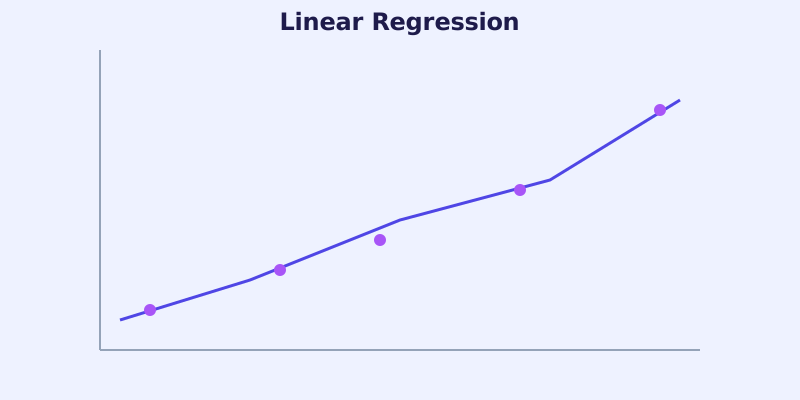
Imagine you’re a business owner trying to predict next month’s revenue based on your advertising spend. Or perhaps you’re a student wondering how study hours translate into exam scores, or a farmer estimating crop yield from rainfall.
In each case, you have two variables: one you can measure or control (ad spending, study time, rainfall) and one you want to predict (revenue, exam score, yield).
Linear regression is the simplest and most fundamental tool for making these predictions. It draws the best-fitting straight line through your data points, giving you an equation you can use to forecast, explain, and understand the relationship between your variables.
In this guide, we’ll cover everything you need to know about simple linear regression: the equation, the math behind it, how to interpret every part of the output, the assumptions you must verify, real-world applications, and common mistakes.
The Core Idea
Linear regression finds the straight line that best describes how a dependent variable changes as an independent variable changes. Think of it as summarizing a cloud of data points into a single, predictable mathematical rule. For complex problems, you might eventually need multiple regression analysis or a step-by-step mathematical walkthrough to see the inner workings.
What Is Linear Regression?
Linear regression is a statistical method that models the relationship between one dependent (response) variable and one independent (predictor) variable by fitting a straight line through the data.
The “simple” in “simple linear regression” means there is exactly one predictor. This distinguishes it from multiple regression, which handles two or more predictors to explain a single outcome.
The goal is to find the line that minimizes the total prediction error across all data points. This line — called the regression line or line of best fit — becomes your model.
Once you have it, you can plug in any value of x and get a predicted value of y. For a deeper technical dive, you can explore the Simple Linear Regression entry on Wikipedia.
Why “Linear”?
The term “linear” refers to the fact that the relationship is modeled as a straight line. If the true relationship between your variables is curved — for example, diminishing returns — a simple linear model may not capture it well.
In such cases, you might need to use a regression curve calculator or explore polynomial regression to better fit your data’s unique shape.
Correlation vs. Regression
People often confuse correlation with regression. Correlation measures the strength and direction of a linear relationship (a single number between −1 and +1). You can calculate this using our Pearson correlation calculator.
Regression goes further — it gives you the equation of the line, so you can make predictions. Correlation tells you “these variables are related”; regression tells you “here’s exactly how they’re related.”
The Linear Regression Equation
The simple linear regression equation takes the familiar form:
Or, using statistical notation:
Where:
- y is the dependent (response) variable — the outcome you’re predicting.
- x is the independent (predictor) variable — the input you’re using to make the prediction.
- b₁ (or m) is the slope — the change in y for every one-unit increase in x.
- b₀ (or b) is the y-intercept — the predicted value of y when x equals zero.
Interpreting the Slope
The slope is the heart of the regression equation. It tells you the rate of change: for every one-unit increase in x, y changes by b₁ units.
Example: If you model exam scores (y) against study hours (x) and get a slope of 5, it means each additional hour of study is associated with a 5-point increase in exam score, on average.
- A positive slope means y increases as x increases (positive relationship).
- A negative slope means y decreases as x increases (negative relationship).
- A slope of zero means there is no linear relationship — the line is flat.
Interpreting the Intercept
The intercept b₀ is the predicted value of y when x = 0. Sometimes this has a clear real-world meaning (e.g., predicted revenue with zero ad spend), but often it’s just a mathematical anchor.
If x = 0 is far outside the range of your data (e.g., predicting salary from years of experience), the intercept may not have a meaningful interpretation. In such cases, what matters is the predictions within your data’s range, not the extrapolated value at x = 0.
The Predicted vs. Actual Equation
An important distinction: the regression equation predicts the average value of y for a given x. Any individual observation will typically differ from the prediction. The full model is:
Where ε (epsilon) is the residual — the difference between the actual and predicted value. This error term captures everything the model doesn’t explain: random variation, measurement error, and the influence of variables not included in the model.
How Linear Regression Works: The Least Squares Method
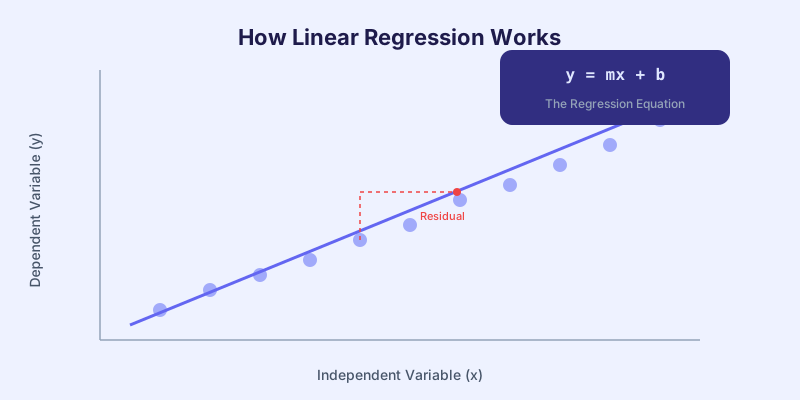
Linear regression uses the method of least squares (also called ordinary least squares, or OLS) to find the best-fitting line. But what does “best-fitting” actually mean?
Residuals: The Distance from the Line
For each data point, the regression line makes a prediction. The difference between the actual y value and the predicted y value is called the residual (or error):
Residual = yᵢ − ŷᵢ
Where yᵢ is the actual value and ŷᵢ (y-hat) is the predicted value from the line.
Some residuals are positive (the point is above the line), some are negative (below the line). If you simply added them up, positive and negative residuals would cancel out, making a terrible line look good. To avoid this, we square each residual before summing.
Minimizing the Sum of Squared Residuals
The least squares method finds the values of b₀ and b₁ that minimize:
This is a calculus optimization problem. By taking partial derivatives with respect to b₀ and b₁, setting them equal to zero, and solving, we get closed-form formulas:
Where x̄ and ȳ are the means (averages) of x and y respectively.
This is why you’ll often see the slope described as the ratio of the covariance of x and y to the variance of x. The numerator captures how x and y move together; the denominator normalizes by how much x varies on its own.
Why Squared Residuals?
You might wonder: why square the residuals instead of using absolute values? Three reasons:
- Squaring penalizes large errors more heavily — a residual of 4 contributes 16 to the sum, while two residuals of 2 contribute only 8 total. This makes the line more sensitive to outliers and generally produces a better fit for the majority of data.
- Squaring makes all values positive, preventing positive and negative residuals from canceling out.
- Squaring produces differentiable functions, which means calculus can be used to find the exact minimum. The sum of absolute values has a “kink” at zero that makes optimization harder.
Step-by-Step: Calculating a Linear Regression
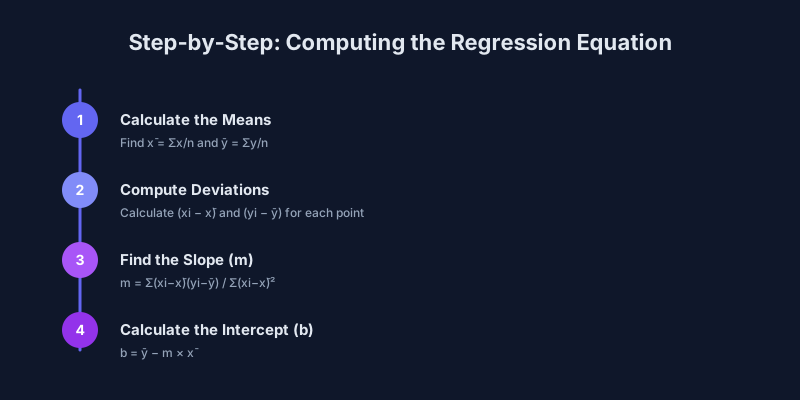
Let’s walk through a complete example with real numbers. Suppose we have the following data showing study hours (x) and exam scores (y):
| Student | Study Hours (x) | Exam Score (y) |
|---|---|---|
| A | 2 | 65 |
| B | 4 | 75 |
| C | 6 | 80 |
| D | 8 | 90 |
| E | 10 | 95 |
Step 1: Calculate the Means
x̄ = (2 + 4 + 6 + 8 + 10) / 5 = 6
ȳ = (65 + 75 + 80 + 90 + 95) / 5 = 81
Step 2: Compute the Deviations and Their Products
| xᵢ | yᵢ | (xᵢ − x̄) | (yᵢ − ȳ) | (xᵢ − x̄)(yᵢ − ȳ) | (xᵢ − x̄)² |
|---|---|---|---|---|---|
| 2 | 65 | −4 | −16 | 64 | 16 |
| 4 | 75 | −2 | −6 | 12 | 4 |
| 6 | 80 | 0 | −1 | 0 | 0 |
| 8 | 90 | 2 | 9 | 18 | 4 |
| 10 | 95 | 4 | 14 | 56 | 16 |
| Sum | 150 | 40 |
Step 3: Calculate the Slope and Intercept
b₁ = 150 / 40 = 3.75
b₀ = 81 − 3.75 × 6 = 81 − 22.5 = 58.5
Step 4: Write the Regression Equation
y = 58.5 + 3.75x
Interpretation: A student who studies 0 hours is predicted to score 58.5 points. Each additional hour of study is associated with a 3.75-point increase in the exam score. A student studying 7 hours would be predicted to score: 58.5 + 3.75 × 7 = 84.75.
Want to skip the manual math? Our Regression Equation Calculator performs all these calculations instantly — with a full step-by-step breakdown so you can see exactly how each number was derived.
Key Statistics: Measuring How Good the Model Is
Getting the regression equation is only half the job. You also need to know how well the line actually fits the data. Several statistics help answer this question.
R-Squared (R²)
R² (the coefficient of determination) measures the proportion of variance in y that is explained by x. It ranges from 0 to 1:
- R² = 0 — the model explains none of the variation in y (the line is flat)
- R² = 1 — the model explains all the variation (every point falls exactly on the line)
- R² = 0.85 — 85% of the variation in y is explained by x
The formula:
Where SSᵣₑₛ is the sum of squared residuals (unexplained variation) and SSₜₒₜ is the total sum of squares (total variation in y).
As a rule of thumb:
- R² > 0.7 — strong relationship (common in physical sciences)
- 0.3 < R² < 0.7 — moderate relationship (common in social sciences)
- R² < 0.3 — weak relationship (the model may not be very useful)
Correlation Coefficient (r)
The Pearson correlation coefficient r measures the strength and direction of the linear relationship between x and y. It ranges from −1 to +1:
- r = +1 — perfect positive linear relationship
- r = 0 — no linear relationship
- r = −1 — perfect negative linear relationship
For simple linear regression, R² = r². The sign of r tells you the direction of the relationship, and squaring it gives you the proportion of variance explained.
Standard Error of the Estimate
The standard error of the estimate (Sₑ) measures the average distance that the observed values fall from the regression line. It’s in the same units as y, making it intuitive:
A smaller Sₑ means the data points are closer to the line — the predictions are more precise. Roughly, about 95% of actual values will fall within ±2Sₑ of the predicted value.
P-Values and Statistical Significance
The p-value for the slope tests the null hypothesis that the true slope is zero (i.e., no linear relationship). A small p-value (typically < 0.05) means the observed relationship is unlikely to be due to chance, and the slope is statistically significant.
Key points about p-values:
- p < 0.05 — statistically significant at the 5% level
- p < 0.01 — statistically significant at the 1% level (stronger evidence)
- p > 0.05 — not statistically significant; the relationship may be due to random variation
- A significant p-value does not mean the model is good — it only means the slope is probably not zero. Always check R² and residual plots too.
The Four Key Assumptions of Linear Regression
Before you can trust the results of a linear regression, you must verify that the data meets four critical assumptions. Violating these can produce misleading coefficients and unreliable predictions.
You can use our regression assumptions checker to test your data automatically against these criteria.
1. Linearity
The relationship between x and y must be approximately linear. If the true relationship is curved, a straight line will systematically mispredict in certain ranges.
How to check: Create a scatter plot of x vs. y. If the points follow a curve, the linearity assumption is violated. Also check residual plots — a random scatter of residuals supports linearity.
2. Independence of Errors
Residuals must be independent of each other. This is especially important for time-series data, where consecutive observations are often correlated.
3. Homoscedasticity (Constant Variance)
The variance of residuals should be roughly constant across all predicted values. If the spread of residuals increases or decreases with the predicted value (a “funnel” shape), the model has heteroscedasticity.
4. Normality of Residuals
The residuals should be approximately normally distributed. This assumption matters for valid hypothesis tests (p-values) and confidence intervals.
Interpreting the Output: What to Look For
When you run a linear regression (whether using our calculator, R, Python, or Excel), the output typically includes several key numbers. Here’s what each one tells you:
Slope (b₁) and Its Confidence Interval
- Sign — positive or negative relationship direction
- Magnitude — the size of the effect in original units (e.g., “3.75 points per hour”)
- 95% confidence interval — the range within which the true slope likely falls. If the interval doesn’t contain zero, the relationship is statistically significant at the 5% level.
R² Value
- Indicates what percentage of the variation in y your model explains
- High R² doesn’t automatically mean the model is good — it could reflect overfitting or an outlier driving the result
- Low R² doesn’t mean the model is useless — in some fields (social sciences, biology), even modest R² values can be meaningful
p-Value for the Slope
- Tests whether the observed relationship could be due to random chance
- p < 0.05 is the conventional threshold for statistical significance
- A very small p-value with a low R² means: “the relationship is real, but weak”
Residual Standard Error
- The typical size of prediction errors, in the same units as y
- Useful for constructing prediction intervals: roughly, 95% of observations fall within ±2 × Sₑ of the predicted value
Real-World Applications of Linear Regression
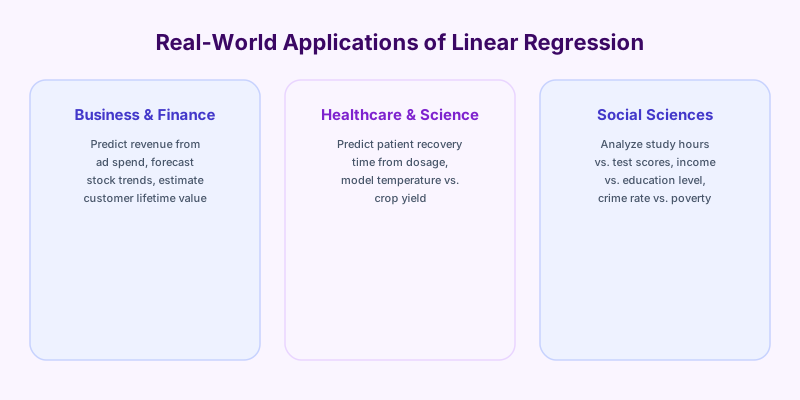
Linear regression is one of the most widely used statistical techniques across virtually every field. Here are some of the most common applications:
Business and Economics
Companies use linear regression to forecast sales from advertising spend, predict demand from price changes, and estimate costs from production volume. Economists model the relationship between consumer spending and income, or between unemployment and inflation (the Phillips Curve).
Science and Engineering
Physicists use linear regression to calibrate instruments (e.g., converting sensor readings to physical quantities). Biologists model the relationship between temperature and reaction rates. Engineers predict material fatigue from stress cycles.
Healthcare and Medicine
Researchers examine how dosage relates to drug efficacy, how BMI correlates with blood pressure, or how exercise frequency relates to cholesterol levels. Clinical trials often use regression to quantify treatment effects while controlling for baseline characteristics.
Education
Schools and researchers predict student performance from study time, attendance, or socioeconomic indicators. This helps identify at-risk students early and allocate resources effectively.
Sports Analytics
Teams and analysts use linear regression to predict player performance from training metrics, estimate win probability from game statistics, and evaluate the impact of coaching changes.
Environmental Science
Scientists model the relationship between CO₂ concentration and temperature, between pollutants and health outcomes, or between rainfall and crop yield — informing policy and resource management.
Common Mistakes and How to Avoid Them
Even experienced analysts can fall into these traps when using linear regression:
Extrapolation
Don’t predict outside the range of your data. If your data covers study times from 2 to 10 hours, predicting the score for someone who studies 50 hours is unreliable — the relationship may not remain linear at extreme values.
Prevention
Confusing Correlation with Causation
A significant regression slope means x and y are associated — it does not mean x causes y. Ice cream sales and drowning deaths are both correlated with temperature, but eating ice cream doesn’t cause drowning.
Prevention
Ignoring Outliers
A single extreme data point can dramatically shift the regression line, especially in small datasets. This is because least squares penalizes large errors quadratically — an outlier with a large residual exerts disproportionate influence.
Prevention
Assuming Linearity Without Checking
Not all relationships are linear. Diminishing returns, threshold effects, and exponential growth all produce curved relationships that a straight line will poorly represent.
Prevention
Over-relying on R²
A high R² doesn’t guarantee a good model. You can have a high R² with violated assumptions, meaningless relationships, or poor predictive performance on new data. Conversely, a low R² in some contexts (like predicting human behavior) may be perfectly acceptable.
Prevention
Small Sample Sizes
With very few data points, the regression line is highly sensitive to individual observations. The slope might look impressive but be statistically non-significant due to the small sample.
Prevention
When to Use (and Not Use) Linear Regression
Use linear regression when:
- You have one predictor and one outcome variable.
- The relationship appears approximately linear.
- Your dependent variable is continuous (numeric).
- You want a simple, interpretable model.
Avoid linear regression when:
- Your outcome is categorical (e.g., pass/fail).
- The relationship is clearly curved — in this case, try a quadratic regression calculator or exponential regression calculator.
- You have multiple predictors — use multiple regression instead.
- Your data has severe autocorrelation.
Linear Regression vs. Other Techniques
Linear regression is just one tool in the statistical toolbox. Here’s how it compares to alternatives:
| Technique | When to Use | Key Difference |
|---|---|---|
| Multiple Linear Regression | 2+ predictors | Handles multiple inputs simultaneously. |
| Logistic Regression | Categorical outcome | Models probability (e.g., 0 to 1 range). |
| Polynomial Regression | Curved relationships | Fits curves using quadratic or higher powers. |
| Exponential Regression | Growth/Decay models | Models data using exponential functions. |
For a broader perspective on how these techniques are used in finance and research, see the Investopedia guide to Linear Regression.
Try It Yourself: Use Our Calculator
Our Regression Equation Calculator lets you enter data points and instantly get the regression equation, slope, intercept, R² value, and a detailed step-by-step breakdown.
Try the Regression Equation Calculator — It’s Free
Key Takeaways
- Linear regression models the relationship between one predictor and one outcome using a straight line.
- The least squares method finds the “best” fit by minimizing squared errors.
- The slope and intercept define the line; R² defines how well it fits.
- Always verify linearity, independence, homoscedasticity, and normality.
- Association is not causation — use domain knowledge to interpret findings.
A Brief History of Linear Regression
The roots of linear regression stretch back to the late 18th and early 19th centuries, born from the needs of astronomers to navigate the stars.
The Method of Least Squares
In 1805, French mathematician Adrien-Marie Legendre published the first description of the method of least squares. However, Carl Friedrich Gauss, arguably the greatest mathematician of his era, claimed he had been using the method since 1795 to predict the orbits of celestial bodies like Ceres. This dispute between two giants of mathematics highlights how critical this tool was for scientific progress.
Sir Francis Galton and “Regression”
The term “regression” itself wasn’t coined until 1886 by Sir Francis Galton. While studying the relationship between the heights of parents and their children, Galton observed that children of very tall parents tended to be shorter than their parents, while children of very short parents tended to be taller. He described this phenomenon as “regression toward mediocrity” (now known as regression to the mean).
What started as a tool for tracking planets and measuring height has since evolved into the backbone of modern machine learning and econometrics.
Deep Dive: Mathematical Derivation of OLS
To truly understand our regression equation calculator with steps , one must peek under the hood at the calculus that drives it. We want to minimize the sum of squared residuals:
To find the minimum, we take the partial derivative with respect to $b₀$ and $b₁$ and set them to zero.
Derivative with respect to $b₀$:
Derivative with respect to $b₁$:
Solving these “normal equations” yields the formulas we use today:
- $b_1 = Cov(x,y) / Var(x)$
- $b₀ = ȳ - b₁x̄$
This derivation ensures that the resulting line is mathematically guaranteed to be the “best” fit for your data under the OLS framework.
Case Study: Predicting Real Estate Energy Costs
Let’s look at a practical application. A property management firm wants to predict the monthly heating cost ($y$) of a building based on the outside temperature ($x$).
The Data: Over 12 months, they record the average temperature and the heating bill.
The Model: They use our free regression equation calculator and find:
Interpretation:
- The Intercept (250): If it were 0 degrees outside, the predicted heating cost would be $250.
- The Slope (-4.5): For every 1-degree increase in temperature, the heating bill drops by $4.50.
The Result: The firm uses this equation to budget for the winter months. When the forecast calls for a 10-degree drop, they know to set aside an extra $45 per building.
Advanced Frequently Asked Questions (FAQ)
1. Is linear regression a machine learning algorithm?
Yes. While it is rooted in statistics, linear regression is considered a “supervised learning” algorithm in machine learning. It is often the first model taught in data science because it is highly interpretable and serves as a baseline for more complex models like neural networks.
2. What happens if my residuals are not normally distributed?
If your sample size is large (typically >30), the Central Limit Theorem helps ensure that your coefficient estimates remain unbiased. However, non-normal residuals can make your p-values and confidence intervals unreliable. You might need to transform your data (e.g., using a log transform) or use a non-parametric regression method.
3. What is the difference between R² and Adjusted R²?
R² tells you how much variance is explained by your model. However, R² will always stay the same or increase as you add more variables, even if they are useless. Multiple regression analysis uses Adjusted R², which penalizes you for adding “junk” variables, providing a more honest assessment of the model’s quality.
4. Can linear regression handle categorical data?
Yes, using dummy variables. For example, if you want to include “Gender” in a model, you can code “Male” as 1 and “Female” as 0. The coefficient then represents the average difference in the outcome between the two groups.
5. Why is it called “Simple” Linear Regression?
It’s “simple” because it only involves one predictor variable. If you add a second or third predictor (like predicting weight from both height and age), it becomes “Multiple” Linear Regression.
6. How do I know if my model is “good”?
A “good” model depends on the field. In physics, an R² of 0.99 might be expected. In psychology or social sciences, an R² of 0.30 could be considered a breakthrough. Always look at the Residual Standard Error to see the average error in the same units as your $y$ variable.
7. What is “Regression to the Mean”?
This is the tendency for extreme scores to be followed by scores that are closer to the average. For example, a student who gets a perfect score on one test is likely to get a slightly lower score on the next, simply because luck usually balances out over time.
8. Does a high R² prove causation?
Absolutely not. You could find a 0.99 R² between the number of pool drownings and the number of Nicholas Cage movies released in a year. This is a spurious correlation. Causation requires a logical mechanism and often experimental data.
9. When should I use a Quadratic vs. Linear model?
If you plot your data and see a “U” shape or an inverted “U”, a straight line will fail. In these cases, you should use a quadratic regression calculator which adds an $x²$ term to the equation.
10. Can I use linear regression for time-series forecasting?
You can, but you must be careful about autocorrelation (where today’s value depends on yesterday’s). If your errors are correlated over time, the standard linear regression assumptions are violated, and you may need specialized time-series models like ARIMA.
Pro-Tips for Using the Regression Equation Calculator
- Clean Your Data: One typo in your data table can ruin your entire model. Always double-check your inputs.
- Standardize Units: Ensure all your $x$ values use the same units (e.g., don’t mix inches and centimeters).
- Check the Range: Only trust predictions that stay within the minimum and maximum values of your input data.
- Use Visuals: Always look at the scatter plot generated by the regression equation calculator with steps to ensure a line is actually appropriate.
By following these principles, you can turn raw data into powerful insights using the world’s most trusted statistical tool.